Technical report / Research edition 01
Lashley
Memory for changing facts.
A bi-temporal architecture for long-lived agents. Update semantics, executable checks and preliminary evaluation.
12 pages · English · Preliminary technical report · Not peer reviewed
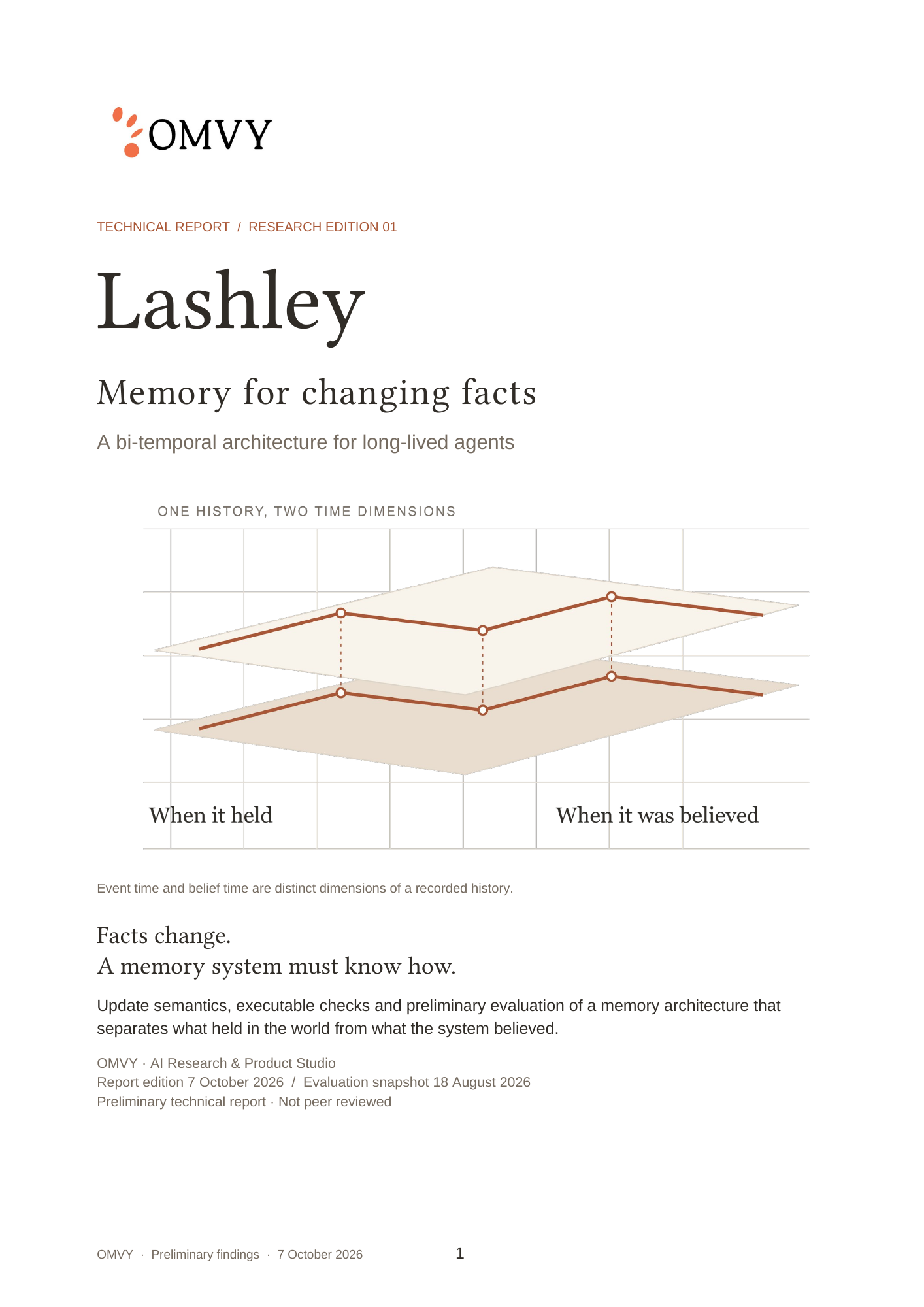
A useful memory must do more than retrieve an old statement. It must distinguish what still holds, what changed and what the system previously believed.
When facts change, what should memory do?
A teammate changes roles. A decision is revised. A commitment moves to another date. Retrieving the original conversation can be accurate and still give the wrong answer today.
This report examines how Lashley represents those changes without losing the relevant history. Its temporal core separates two questions that are easy to confuse.
- Event time
- When did the fact hold in the world?
“Where did Marco work in February?” - Belief time
- When did the system hold that belief?
“What did we believe in February?”
Bi-temporality is established database practice, not a new invention of Lashley. The report focuses on how update intent, temporal postconditions and verification work together in an agent memory system.
Three contributions
01 / An explicit update model
World-state transition, retroactive correction, dissent, deferral and cancellation have different effects on memory. The evaluated passive-ingest path routes four outcomes; full retroactive correction requires explicit temporal authority.
02 / Checks with a defined scope
Seeded programs exercise public write operations and check edge-level integrity, incidental retirement and fragment bounds. Functional-slot enforcement and concurrency are separate claims, with separate limits.
03 / A temporal evaluation instrument
TULVING generates a deterministic synthetic world and gold timeline, making questions about current facts, past events, prior beliefs and commitments explicit.
What does the evidence show?
The evaluated implementation added a belief-time query route that was absent from the earlier benchmark interface. Four later, non-paired runs returned 12–19 correct answers out of 90, compared with 0/90 before. Other code and run-level differences prevent a causal accuracy claim.
This is a limited capability observation, not a claim of high retrieval quality or superiority over another memory system. All reported runs use one generated world; paired cross-system comparisons and the intent ablation were not completed, and the audit metric remains under reconciliation.
The report also covers episodic and prospective memory, scheduled maintenance, outcome monitoring and the operational limits of historical reading. Internal tests remain author-reported evidence, not independent verification.
Scope and availability
Research edition 01 is a condensed technical report prepared on 7 October 2026 from the August manuscript. Its results describe the evaluation snapshot of 18 August, not product changes made after that date. The experiments were not rerun for this edition.
The engine is proprietary. The source manuscript describes a benchmark package prepared for release but cites no immutable public archive. This edition does not verify a subsequent release. The report is preliminary and has not been peer reviewed.
Cite this report
OMVY. (2026). Lashley — Memory for changing facts: A bi-temporal architecture for long-lived agents. Research edition 01, 7 October 2026. Technical report. Evaluation snapshot: 18 August 2026.
PDF · 12 pages · English